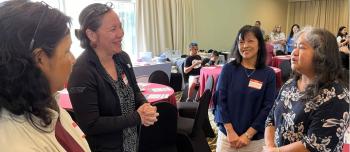


The National Bleeding Disorders Foundation (NBDF) honored emerging researcher Paxton Mills with the 2026 Lived Experience Expert of the Year Award at its Bleeding Disorders Conference in Orlando, Florida this August. Paxton is a person who has never let her bleeding disorder define her but instead has used it to inspire her research aspirations and future career.
When Experience Inspires Research
Women and girls in the bleeding disorders community know that having their symptoms taken seriously by medical professionals is an ongoing problem. Their experiences reflect a broader issue in bleeding disorders research: women have historically been excluded from studies, and their symptoms are often minimized. Filling in those gaps in understanding requires researchers who are willing to ask questions about women’s experiences from the people who know them best – the women themselves. Paxton Mills is an undergraduate researcher who lives with a rare platelet disorder, and her own lived experience as a woman with a bleeding disorder drove her quest for answers.
Paxton was diagnosed roughly a decade after her first symptoms emerged. Her mother reached a diagnosis last fall at 58 years old, a delay of nearly 50 years since the beginning of her symptoms. “I thought that this might be a greater issue, bigger than any one individual, but something more pervasive in our community that females are grappling with,” Paxton said.
Her journey to learning more started with NBDF's National Youth Leadership Institute (NYLI), a two-year program designed to shape young people from the bleeding disorders community into well-trained, recognized leaders. Paxton enrolled in the research track, where she was able to connect with NBDF’s research department, and for her capstone project, she wanted to explore if her difficulty obtaining a diagnosis for a bleeding disorder could be validated through data.
Turning Experience into Data
For her research project, she collaborated with members of NBDF’s research department on a study examining self-reported diagnostic delays among people living with bleeding disorders. She found that 46% of females reported waiting more than 10 years between their symptom and diagnosis, especially for conditions other than von Willebrand disease. This is in comparison to almost 60% of males, who were diagnosed within the first year of showing symptoms.
Her research, co-authored by Maria Santaella, PhD(c), MSN, RN-BC and Samantha Carlson, LMSW, of NBDF’s research department, along with Marissa Jones, and Cynthia Nichols, PhD, was accepted for presentation at the 2025 meeting of the Hemostasis and Thrombosis Research Society (HTRS) and published as an abstract in the journal Research and Practice in Thrombosis and Hemostasis. For Paxton, the recognition was a major accomplishment for an undergraduate student, and a meaningful one as a member of the bleeding disorders community.
The findings confirmed what she and many other women in the bleeding disorders community experienced. But there was one bright spot that emerged from her data. “We also found evidence that these diagnostic delays are shortening with each generation of females, as younger females appear to be waiting for shorter periods of time than their older counterparts.”
A Lived Experience Expert
Paxton describes herself as a “lived experience expert,” a concept central to NBDF’s research strategy. Lived experience experts are individuals, their caregivers and family members who are directly impacted by bleeding disorders. Being a lived experience expert who is also a scientist has provided me with a valuable lens," she says. "I can analyze the challenges faced by our community, formulate relevant research questions, and consider potential solutions, all from the position of being immersed and on the ground in this community."
Lived experience experts play a central role in NBDF’s research strategy, and, by extension, Paxon’s research. Her project used data from NBDF’s Community Voices in Research (CVR), a community-powered registry that collects information directly from adult lived experience experts without filtering responses through an intermediary, such as a doctor or nurse. It captures information not only related to current treatments and therapies, but also gathers data on issues such as mental health, family dynamics, treatment adherence, and barriers to access to care across the lifespan. The result is data that reflects the full texture of life with a bleeding disorder directly from the people living it.
Her current project examines the relationships between social determinants of health, including race, diagnosis, ethnicity, education, employment, income, and transportation access, and reported reproductive bleeding, measured through the Ruta menorrhagia index, a tool that measures blood loss during periods. It is work driven by her conviction that certain subgroups within the bleeding disorders community are often left out of the conversation and therefore left out of the data.
"In order to improve health outcomes for everyone living with a bleeding disorder, no matter their sex, race, diagnosis, or geographical location, you must first understand their experiences," she says. "Our data must be representative of our entire community if we expect to move forward."
A Look Ahead
Paxton was able to build upon the research outlined in the abstract with an additional project through an extended internship with NBDF. Through this, continuing to use the data in CVR, she is working on a manuscript expanding on her findings and exploring miscarriage and pregnancy-related data for women and girls with bleeding disorders, another area where the community's needs have historically outpaced the available evidence.
None of this would be possible, she notes, without the support of NBDF. “I have the utmost gratitude for Maria Santaella, the senior vice president of research strategy, and the entire research department,” she said. “Maria is a trusted mentor and phenomenal partner in advancing women and girls with bleeding disorders. She has wholeheartedly supported my development into a more skilled and confident scientist.”
Paxton graduated Phi Beta Kappa and summa cum laude from University of Richmond in the spring of 2026, earning a bachelor’s degree in molecular biology and biochemistry. She plans on attending medical school to study hematology. She will bring the research experience, scientific grounding, and understanding of the bleeding disorders she has built over the course of her studies and her work with NBDF. She enters the next phase of her career with a growing body of research and a commitment to improving how women and girls with bleeding disorders are represented in science.